



Why Are My LED Lights Flickering: Common Causes and Fixes for Australian Homes
Why are my LED lights flickering?
As an electrician in Perth, I’ve seen LED lights flickering in bedrooms, kitchens, bathrooms, garages, offices, shops, outdoor areas, and even in freshly renovated homes where the lights were installed only recently.
Sometimes, flickering LED lights are caused by something simple. Other times, lights flickering can point to something more serious.
We usually start by looking at the pattern. Is one light flickering, or are several LED lights flickering at once? Does the light flashing happen when the air conditioner starts? Does it only happen at night? Does the LED ceiling light flickering come with buzzing, heat, or a burning smell?
You can safely check basic things, such as whether the bulb is loose or the fitting looks damaged on the outside. But please don’t open switches, fittings, power points, or the switchboard.
If the flicker keeps coming back, it’s worth booking professional electrical services before a small warning sign becomes a bigger problem.
Why Do LED Lights Flicker?
As an electrician, I usually see LED light flickering as a sign that the light is not getting a clean, steady power supply. LEDs are sensitive. That is why flickering LED lights can show up even when the rest of the house seems to be working fine.
So, why do LED lights flicker? The cause can be simple.
It can be a loose LED bulb, a faulty globe, or a misaligned bulb. Other times, it’s due to an incompatible dimmer. Another problem could be a poorly designed or broken LED driver, which may cause LED flashing, light blinking, or a strobing effect.
I have also noticed that LED lights flicker when the voltage in my home changes. For instance, the lights may flicker when the air conditioner is turned on, the fridge cycles on, the washing machine is running, or power tools are used in the garage.
This is why light flickering is dependent on the pattern. One flickering bulb may be minor. Multiple lights flickering could indicate a problem with a larger circuit, wiring, voltage, or supply.
During or after storms, if lights are dull or flickering, this could be a sign of either low voltage or partial supply, and that the electricity company should be called immediately.
The questions we usually ask are when the flicker occurs. Is it only one light? Only when dimmed? Only at night? Only after appliances are switched on? That helps to narrow down what causes flickering lights before we recommend how to fix them.
A simple way to understand this is to look at volts, amps, and watts, because LED performance depends on the right electrical balance.
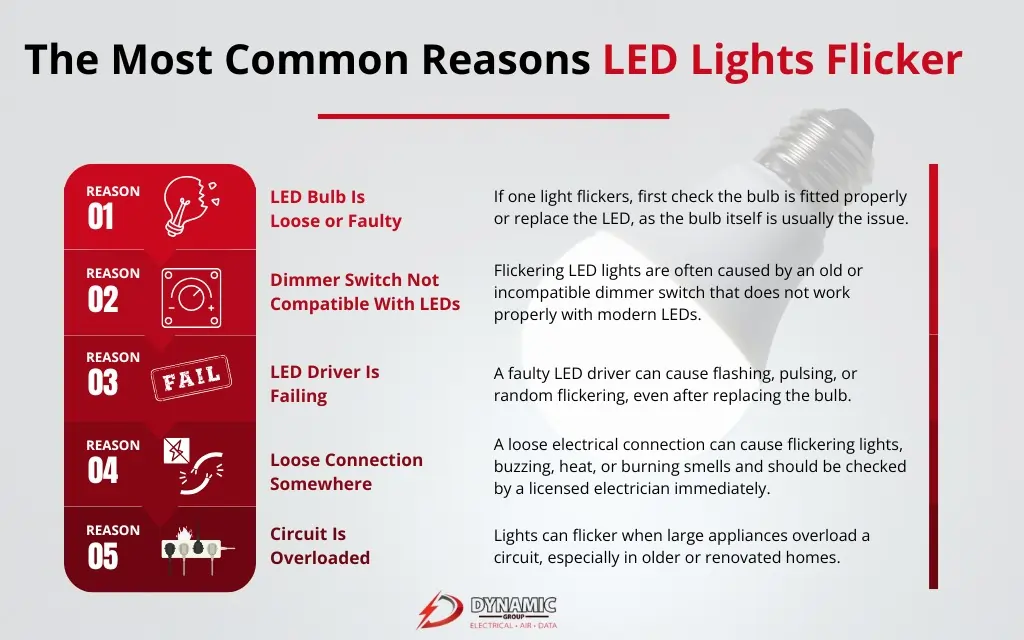
The Most Common Reasons LED Lights Flicker
I don’t immediately assume the worst when someone complains about their LED light flickering. I normally follow the pattern first, most of the time.
Is it one light? A whole room? Only when dimmed? Only when the air con kicks in?
That will help me determine whether it’s a simple LED-bulb flickering issue or a deeper problem in the circuit. These are the most frequent causes that I see.
The LED Bulb Is Loose or Faulty
If only one light is flickering, start with the easy stuff.
The bulb may not be properly seated in the fitting. At other times, the LED is faulty, of low quality, or has reached the end of its useful life.
What I’d check first:
- Turn the light off.
- Let the bulb cool.
- Make sure it is fitted properly.
- Replace it with the correct LED type.
If it’s a new bulb and it works, then all is well. If the light bulb flickers again, it is likely not the problem.
The Dimmer Switch Is Not Compatible With LEDs
This is one of the primary causes of flickering LED lights, especially in Australian households that were upgraded from halogen downlights.
The older dimmers were typically designed for an incandescent or halogen bulb. The old dimmer may not work smoothly with LEDs, as they consume much less power.
Not all dimmers are compatible with all dimmable LED lamps, and older dimmer types can cause inconsistent performance, such as flickering.
Signs this may be your issue:
- The light flickers when dimmed
- buzzing from the switch or fitting
- lights flashing at low brightness
- The light does not switch off properly
- The ceiling light flickering stops when the brightness is turned up
If you are familiar with this, the fix may be an LED-compatible dimmer or a proper lighting installation check. Do not simply change bulbs and hope for the best.
The LED Driver Is Failing
Many LED fittings, particularly downlights, have a driver. Think of it as the part that helps regulate power so the LED can run properly.
If the driver is poor quality, old, overheated, or damaged, you may notice:
- LED light flashing
- dull pulsing
- delayed start-up
- random flicker
- One downlight is behaving differently from the rest
That is why some people may be asking, “Why is my LED downlight flickering despite having replaced the bulb?” The answer is usually that it wasn’t the bulb.
This is where good fault-finding comes in. An electrician can test whether the problem lies with the driver, fitting, dimmer, or supply, rather than guessing.
There Is a Loose Connection Somewhere
Now we move from “annoying” to “please don’t ignore this”.
A loose connection may occur at the light fixture, switch, junction box, or circuit. It can cause intermittent power, which may make the light flicker one minute and behave the next.
Watch for these warning signs:
- lights flickering across multiple fittings
- buzzing or crackling sounds
- burning smell
- warm switch plate
- flickering that gets worse over time
- flicker after touching the switch
If you see these, I would not consider it a do-it-yourself job. The duty to have electrical wiring work carried out by a licensed electrician is the responsibility of the property owner.
A loose connection may also induce heat and/or arcing. If you are wondering what a short circuit is, note that some wiring problems can cause current to take an unintended path, which can be hazardous.
The Circuit Is Overloaded
Sometimes, why your lights flicker has less to do with the light and more to do with what else is running.
This can occur when a large appliance draws power from the same circuit or a nearby one. It may be due to renovations in older homes or to the addition of an appliance in a renovated home. The circuit may need testing if this is the case.
If the circuit breaker keeps tripping, do not keep resetting it without first figuring out why it is tripping. Don’t operate a breaker as an on/off switch.
| When the Flicker Happens | What It Might Mean |
|---|---|
| One LED flickers | Loose of faulty bulb |
| Flickers only when dimmed | Incompatible dimmer |
| Flickers after replacing bulbs | Possible driver or fitting issue |
| Several rooms flicker | Circuit, wiring, or supply issue |
| Flickers when appliances start | Voltage drop or overloaded circuit |
| Flickering with buzzing or burning smell | Call a licensed electrician urgently |

Is LED Light Flickering Dangerous?
Sometimes, yes. Sometimes, no. That is the honest answer.
As an electrician, I’m not afraid of every LED light flickering. A single bulb in a flickering lamp can be due to any number of reasons. That’s a nuisance, but not necessarily a crisis.
But there are times when flickering LED lights need to be taken seriously.
Here is the line I usually give to my clients:
“A little flicker can be a light issue. Flickering with other warning signs can be an electrical issue.”
Call someone in if you notice:
- lights flickering across several rooms
- buzzing, crackling, or popping sounds
- a burning smell near a switch, fitting, or switchboard
- warm switches or power points
- sparks
- The circuit breaker keeps tripping
- LED lights flashing after a storm or outage
Flickering lights, tripping fuses, appliances cutting in and out, or burning smells could be due to an electrical fault. They should be inspected by a licensed electrician, according to a South Australian Government energy guide.
Storms can also change the picture. Heavy rain, wind, damaged lines, network faults, or any combination of these may cause power outages. Power outages may result from equipment problems, severe weather, or power lines falling, and it also allows customers to report flickering lights as outage-related issues.
So, what do flickering lights really mean? Pattern.
The fitting, globe, driver or dimmer is checked if one light flickers. If several lights keep flickering (particularly after storms or when appliances are switched on), we investigate further.
This is where Dynamic Group can be of assistance—helping test the circuit, assess the power supply, and safely fix power outages and related issues.
What Should You Check Before Calling an Electrician?
There are a couple of safe things you can do before calling an electrician. At Dynamic Group, I always remind customers to perform basic visual checks but never to open switches, fittings, power points, or the switchboard.
With the LED light flickering, the pattern tells us a lot. One LED bulb flickering is very different from several lights flickering across the house.
Here’s the quick checklist I’d run through:
- Is only one LED flickering? – It could be a loose bulb, a faulty globe, or a tired LED driver.
- Does it stop after replacing the bulb? – If yes, the issue may have just been the bulb.
- Does it only happen when you use the dimmer? – Often this is due to a wrong dimmer. Some older dimmers won’t work with newer LEDs.
- Does it happen when a large appliance turns on? – If the light flickers when the air conditioner, refrigerator, washing machine and power tools switch on, then it could be a voltage or circuit load problem.
- Are several rooms affected? – Multiple flickering LED lights can mean something bigger than one bad bulb.
- Is there buzzing, heat, or a burning smell? – Stop there. That is not a “wait and see” situation.
- Has the circuit breaker tripped recently? – A breaker trip plus light flashing can point to a fault that needs testing.
- Did it start after a storm or power outage? – If your neighbours also have lights flashing or dimming, make note of the time it begins.
There is no room for do-it-yourself electrical wiring in Australia. The NSW Government states that electrical wiring work should only be undertaken by a licensed electrician. In contrast, Queensland’s Electrical Safety Office states that unlicensed DIY electrical work will not ensure safety and protection.
It is safe to test the bulb, the lamp, and the plug type if it is a plug-in fitting. However, if the light keeps flickering, Dynamic Group can make a proper test to determine what is actually happening.

When Should You Call a Licensed Electrician?
I’d call a licensed electrician when the LED light flickering stops looking like a one-off bulb problem and starts acting like a pattern.
These are the warning signs you would not ignore:
- Flickering happens across several rooms
- The same light keeps flickering after you replace the bulb
- Switch plates feel warm
- You hear buzzing, crackling, or popping
- There is a burning smell near a switch, light, or switchboard
- The circuit breaker keeps tripping
- The light flashing started after new lights, switches, appliances, or renovations
- Your home has older wiring
- You notice LED lights flashing after storms, outages, or heavy appliance use
The National Fire Protection Association (NFPA) identifies the following as electrical hazards in the home: warning sounds of warm outlets, burning or rubbery odours, repeated fuse or circuit breaker problems, and flickering lights.
Electrical work may cause shock, injury, or death, and that it should only be carried out by a licensed or registered electrician.
So, if you’re asking, “Why are my lights flickering?” and the answer is not obvious, don’t start pulling things apart.
The licensed electrician can test the circuit, inspect the fittings, check the switchboard, test for voltage problems, and determine the cause of flickering lights without relying on guesswork.
This is where qualified residential electricians can professionally inspect your home’s lighting circuit. Commercial electricians can test more extensive lighting systems and heavier electrical loads in shops, offices, warehouses, and other workplaces.
Can You Fix Flickering LED Lights Yourself?
Yes — but only up to a point.
As an electrician, I’m all for simple checks. If you have an LED light flickering in one room, it doesn’t necessarily indicate a serious problem with the wall. Sometimes, it’s as simple as a loose bulb.
Here’s what you can safely check first:
- Check if the bulb is loose. Turn the light off, let it cool, then make sure the bulb is fitted properly.
- Try the correct LED type. A wrong or poor-quality bulb can cause LED flashing, light blinking, or a strange strobe effect.
- Check if the bulb is dimmable. If the light flickering only happens on a dimmer, the bulb or dimmer may not be compatible.
- Notice when it happens. Does it flicker when the air con, fridge, washing machine, or power tools turn on?
- Unplug sensitive appliances during power issues. This can help protect electronics during unstable supply or storm-related problems.
But here’s where I draw the line.
- Do not open switches.
- Do not remove fittings.
- Do not touch wiring.
- Do not inspect the inside of the switchboard.
- Do not bypass a tripping breaker.
Also, please don’t assume you know the colours of electrical wires and deal with them from there. It’s where things can get ugly.
Undertaking DIY electrical work is dangerous and may lead to electrocution and fire, and that it is illegal for unlicensed individuals to undertake fixed wiring work.
It also recommended that you refrain from operating any damaged or faulty electrical devices, switch off the power, unplug the devices safely, and do not attempt any self-repair on electrical appliances.
We’d prefer you test the easy stuff first, but if the flickering LED lights keep happening, give us a call. That is the safer way to work out how to fix flickering LED lights without guessing.
Do Not Ignore Persistent LED Lights Flickering!
If your LED light flickers once and disappears after replacing a bulb, it may not be a big drama. Sometimes, flickering LED lights are caused by a loose globe, an incompatible dimmer, or a failing LED driver.
But if the flickering lights keep coming back, affect several rooms, or are accompanied by buzzing, heat, burning smells, flashing lights, or a circuit breaker that keeps tripping, I would not ignore it.
I always tell people this: don’t keep guessing. If the light keeps flickering, there is a reason.
Dynamic Group can help by properly checking your lighting setup, testing for faults, repairing damaged or unsafe parts, and ensuring your LEDs are installed correctly.
If your home or business needs a safer electrical setup, we can also assess whether a switchboard upgrade is needed.
Still dealing with LED lights flickering? Contact us today. We’ll inspect the issue, find the cause, and recommend the safest fix for your home or business.

Unmatched Electrical Services
Explore our services and see why we're recognised as one of Perth's top electrical service providers. Our dedication to exceptional customer care, clear communication, and the unmatched expertise of our experienced team make us stand out.

Competive Rates

Clean Work Sites

5-Star Service

Licenced & Qualified
Get in Touch Now
Complete the form below to get a customised quote or to have your queries answered.