

The cost of EV charger installation in Australia depends on the charger, the property, and the amount of electrical work required. As a rough guide, Energy Victoria says Level 1 charging can typically cost $500 to $2,000, while Level 2 charging can cost $1,000 to $3,000, depending on charger speed and site complexity.
A simple home installation is usually much more straightforward than a commercial setup. If the charger is going in a garage or carport close to the switchboard, and the home already has enough electrical capacity, the cost of an EV charger at home is usually easier to manage.
We always recommend checking the site before choosing a charger. That way, you get a clearer idea of the real cost of installing an electric car charger, not just the price of the unit itself.
Average EV Charger Installation Cost in Australia
The EV charger installation cost in Australia is generally between $750 and $1,500 for a straightforward Level 2 installation, excluding the charger itself.
Complex installations requiring additional cabling, trenching, load management or switchboard upgrades may cost $2,000 to $3,000 or more.
Level 1 charging costs in Australia are typically $500-$2,000, and Level 2 charging costs are typically $1,000-$3,000, depending on the charger speed and site complexity.
Typically, an at-home EV charger installation is more cost-effective when located near the switchboard and existing electrical capacity.

It is a type of job we really like seeing at Dynamic Group, as it is often less of a surprise: less cabling, easier access, and less time spent modifying the existing electrical installation.
The more complex the installation, the more expensive it will be. With long cable runs, trenching, wall penetrations, additional circuit protection, load management, and switchboard installation, the cost of installing an electric car charger may increase. This is one reason for the different quotes for two homes with the same charger.
The cost of the charger must also be distinguished from the installation costs for Tesla owners. Tesla Australia shows the price of the Mobile Connector at $550 and the Gen 3 Wall Connector at $800. For the Wall Connector, AGL offers a Tesla choice for $795 (standard installation at $1,099).
A basic cost breakdown usually looks like this:
 Cost Breakdown
| Cost Item | What It Covers | Typical Cost Impact |
|---|---|---|
| Charger Unit | Wall charger, portable charger, smart charger, or Tesla Wall Connector | $550–$2,500+ |
| Labour | Licensed electrician’s installation, testing and compliance work | $500–$1,200 |
| Cabling | Cable run from the switchboard to the charger location | $20–$50 per metre, depending on access and cable requirements |
| Circuit Protection | Dedicated circuit, breakers, RCDs, isolation switch and other safety equipment | $150–$500 |
| Switchboard Work | Additional capacity, protection changes or switchboard upgrades | $500–$3,000+ |
| Optional Smart Features | Solar integration, app controls, scheduling, load management | Adds convenience but may increase upfront cost |
Cost of EV Charger Plug Types in Australia
This is something I always say to customers when they ask me about the type of plug: don't think of this as a minor technical detail!
It can influence the overall EV charger installation cost, as different plug types require different charging speeds, power levels, installation configurations, and locations.
For instance, most public AC chargers in Australia use Type 2 plugs, and CCS2 is the typical plug for DC fast charging.
Transport for NSW also includes Type 2, CCS2, and CHAdeMO as the standard EV charging plugs in Australia.
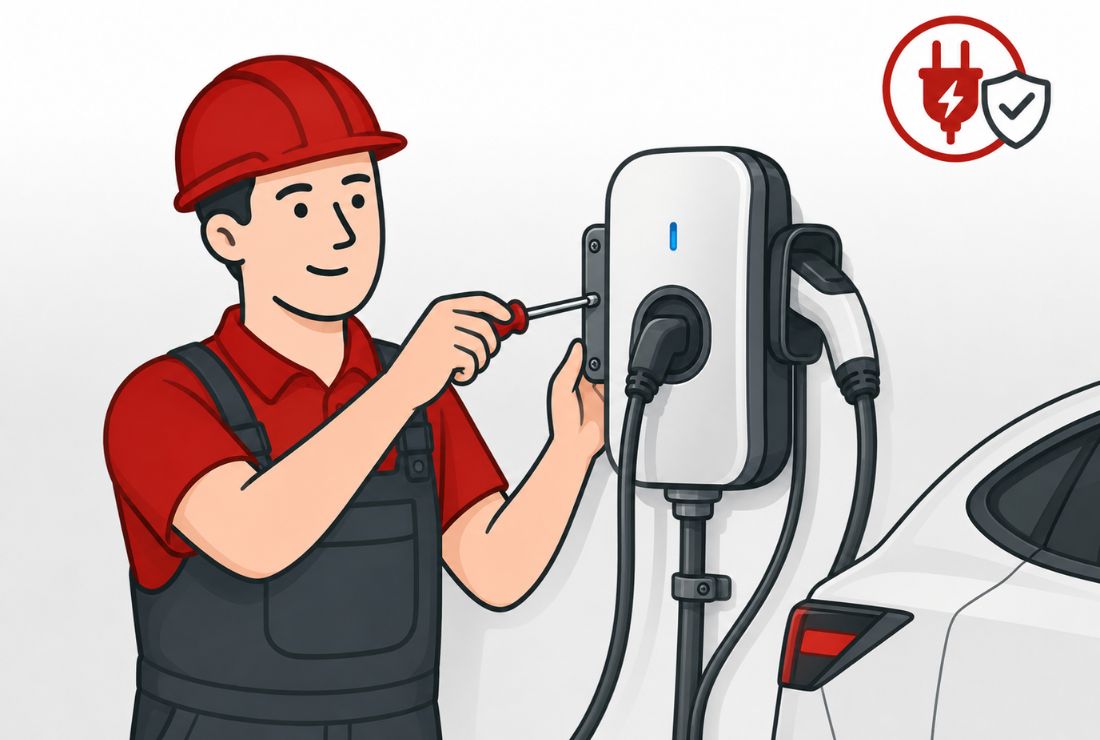
Based on what we can see here at Dynamic Group, most homeowners are considering the standard power point, 15A outlet, Type 2 AC wall charger, or the Tesla Wall Connector.
That's not the case with CCS2 and CHAdeMO. They are typically associated with DC fast charging, public charging stations, commercial charging stations, and fleet charging. Hence, the total cost of an electric vehicle charging station may be significantly greater than that of a standard home charging station.
Also consider compatibility and set up for Tesla owners. According to Tesla Australia, the Wall Connector will be capable of powering up to 22kW and up to 32 amps of AC (230–410V).
So the best plug type is not necessarily the preferred plug type. It must be compatible with the vehicle's charge connector, the property's electrical power, and the charger's actual use.
EV Charger Plug Types in Australia: Cost and Feature Comparison
| Plug Type | Charging Speed | Voltage Requirement | Installation Cost | Installation Complexity | Charge Connector | Compatibility | Common Power Range |
|---|---|---|---|---|---|---|---|
| Standard 10A power point / portable charger | Slow | Standard household supply | $0 when using an existing compliant outlet; approximately $500–$1,200 for a new dedicated outlet or circuit | Low, if the outlet is suitable and safe | Standard household plug | Depends on portable charger and vehicle cable | Around 2.4kW |
| 15A power point | Slow to moderate | Dedicated 15A outlet required | Approximately $500–$1,200 for a dedicated outlet and circuit | Low to moderate | 15A household plug | Depends on vehicle and charger lead | Around 3.6kW |
| Type 2 AC wall charger | Moderate to fast | Single-phase or three-phase AC, depending on setup | Approximately $750–$1,500 for a standard installation; $2,000–$3,000+ if upgrades or extensive cabling are required | Moderate | Type 2 connector | Common for many modern EVs in Australia | Around 7kW to 22kW |
| Tesla Wall Connector | Moderate to fast | 230–410V AC, up to 32A according to Tesla | Approximately $750–$1,500, excluding the Wall Connector; $2,000–$3,000+ for complex installations | Moderate, higher if switchboard work or long cabling is needed | Type 2 connector | Tesla vehicles and selected compatible EVs | Up to 22kW according to Tesla |
| CCS2 DC fast charger | Fast to ultra-fast | Higher-capacity DC charging infrastructure | Approximately $15,000–$60,000+ for installation and site work, excluding charger hardware | High | CCS2 connector | Common DC fast-charging connector in Australia | Varies widely by charger, often much higher than AC |
| CHAdeMO DC charger | Fast, but less common for newer EVs | DC charging infrastructure | Approximately $15,000–$60,000+ for installation and site work, excluding charger hardware | High | CHAdeMO connector | Less common for newer Australian EVs | Often used in older DC fast-charging setups |
What Affects EV Charger Installation Cost?
The quote I give for an EV charger installation cost covers more than just the charger box. I observe the property, its location, the switchboard, the amount of electricity already used on the property, and whether the charger is needed for one car or multiple cars.
The first major concern is the charging speed and the power output. The basic charger that you have at home is different from the commercial one.
Home AC chargers can typically be configured to operate at 7kW to 22kW, and must be installed by a licensed electrician, according to Energy.gov.au. It also highlights the need to upgrade the switchboard or supply connection for a dedicated EV charger.
This is why it's hard to pinpoint a single price for installing an EV charger at home. It is typically easier to install a simple garage installation than a driveway installation on the opposite side of the house.
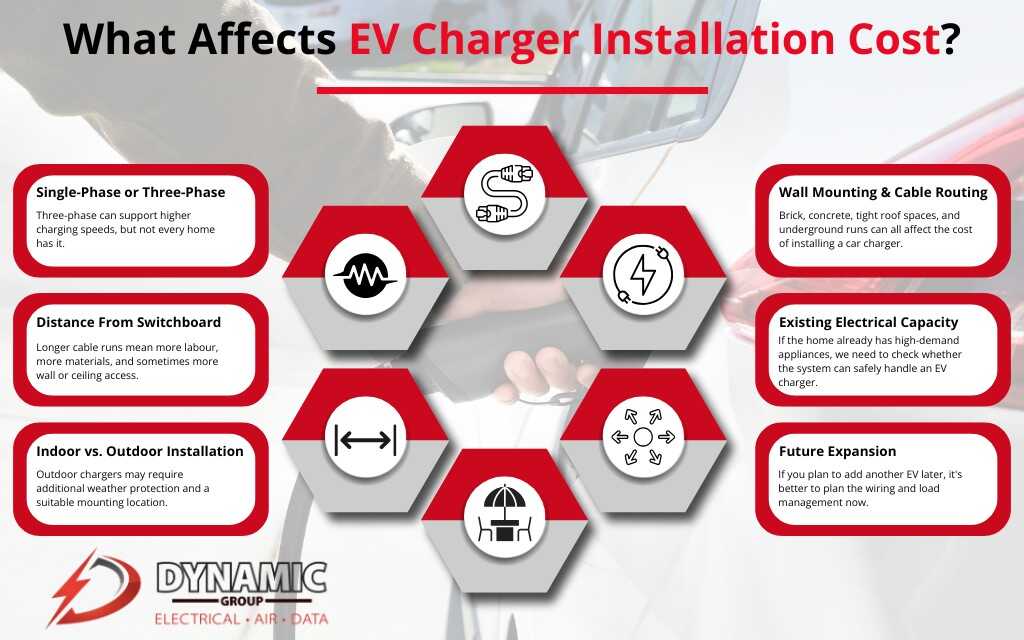
Here are the main things to check:
- Single-phase or three-phase power: Three-phase can support higher charging speeds, but not every home has it.
- Distance from the switchboard: Longer cable runs mean more labour, more materials, and sometimes more wall or ceiling access.
- Indoor vs. outdoor installation: Outdoor chargers may require additional weather protection and a suitable mounting location.
- Wall mounting and cable routing: Brick, concrete, tight roof spaces, and underground runs can all affect the cost of installing a car charger.
- Existing electrical capacity: If the home already has air conditioning, induction cooking, a pool pump, or other high-demand appliances, we need to check whether the system can safely handle an EV charger.
- Future expansion: If you plan to add another EV later, it's better to plan the wiring and load management now.
The government estimates the cost of installing a home charging unit in NSW to be between $200 and $5,000+, depending on the charger and installation. It also advises obtaining quotes from licensed electricians experienced in installing EV chargers.
Older homes are also a focus for the Dynamic Group. Before a charger can be safely installed, the switchboard might need to be upgraded or provided with proper protection, depending on how old, overloaded, or lacking in protection it is.
If the wiring is very old or unsafe, then it might be worth a homeowner's insurance agent taking a look at the expense of rewiring the home before installing another large electrical application.
The same applies to businesses, but on a larger scale. The cost of installing EV charging stations can add up quickly if multiple charging stations, load management, trenching, signage, or charging bays for future use are involved.
Home and Commercial EV Charger Installation Costs
The first question I ask when someone asks me about EV charger installation cost is: Is it for home or business? Two jobs may appear alike, but when we look at the site, there is usually a significant difference in the price. The most common configuration I see at Dynamic Group for a house is a wall charger in a garage, carport, or driveway. This is typically the simpler choice, particularly if there is sufficient electrical capacity within the home and the charger is close to the switchboard.
According to Energy.gov.au, using a standard power point is all it takes to charge at home, although a dedicated EV charger might require a licensed electrician and upgrades to the switchboard or supply.
This is what makes the cost of an EV charger at home fluctuate rapidly. A tidy garage installation is one thing. A driveway charger with long cable runs, outdoor weatherproofing, wall penetrations, or an old switchboard is another. That's where an expert home electrician can make an accurate evaluation before you purchase the charger.
Typical commercial installations are large-scale projects. There may be a requirement for several chargers, increased electrical load, car park works, load management, user access, payment systems, signage, and the ability to accommodate future expansion.
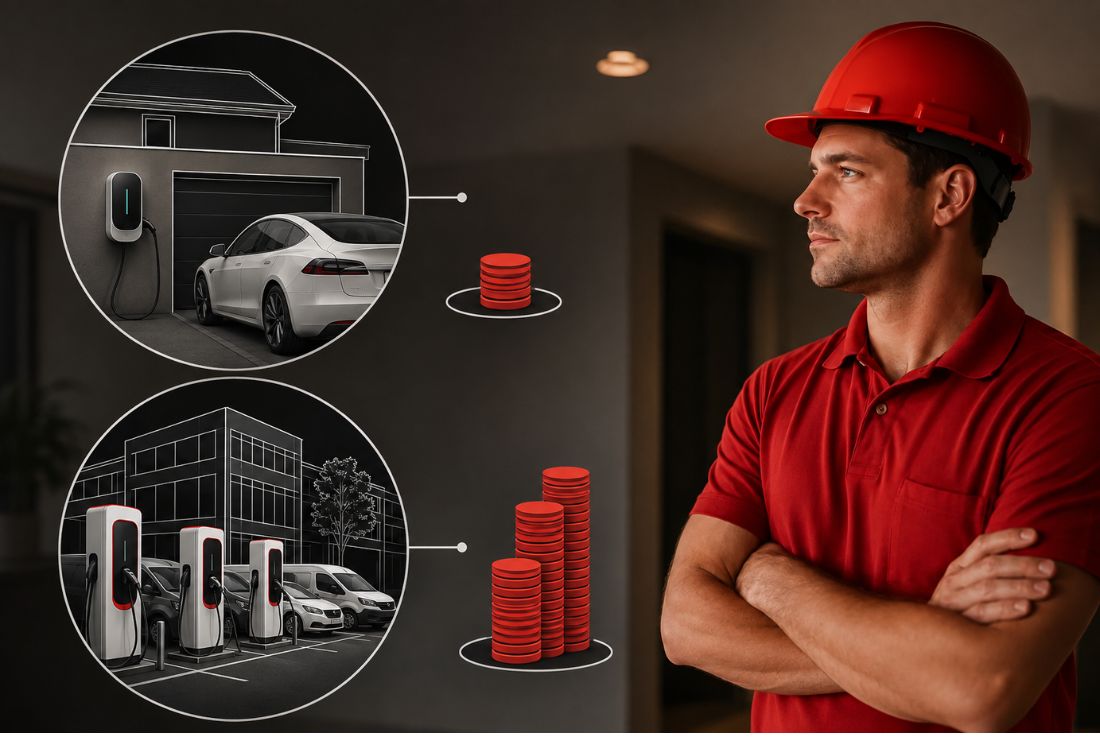
That is why the cost of installing an EV charging station is typically quoted only after a site inspection. So, after a home inspection, if you're wondering how much to install an EV charger at home, it might be quite straightforward. However, if you are wondering how much a commercial EV charging station costs, it's generally a more involved discussion for a licensed commercial electrician.
How to Choose a Charger That Suits Your Needs
When asking about the EV charger installation cost, don’t just consider the charger's price. The lowest-priced unit may turn out to be more expensive if it doesn't match your driving habits, your home electrical system, or your charging needs. Choosing an EV charger is a matter of cost-effectiveness and convenience, and there are chargers available that vary in charging speed, price, and installation difficulty.
- If you only drive short distances: A basic charger or portable charger might be sufficient. This will help reduce the cost of an EV charger at home, but it will typically take longer to charge.
- If you drive daily or want faster overnight charging: A dedicated wall charger is usually the preferred choice. An electric vehicle charging point for AC systems can provide up to 22kW and is often available at workplaces, shopping centres, hotels, and apartment complexes.
- If you have solar: Consider using a charger that is compatible with solar power. One method for charging with home solar is to use the vehicle's standard charger with a standard power outlet during the day, but a more suitable setup depends on the home and charging needs.
- If you are buying for a business: A commercial charger might be necessary for offices, customer parking, and fleet vehicles. When installing EV charging stations, costs can escalate here, as this setup might require more power, load management, and future expansion.
For Tesla owners, the choice is often between a portable Tesla Mobile Connector and a fixed Tesla Wall Connector. The Mobile Connector comes with 10A and 15A adaptors, and the Wall Connector is touted as Tesla's "fastest home charging solution" and can power multiple Wall Connectors.
Tips for Cost Savings
My top tip for someone focused on keeping their EV charger installation costs in check is simple: plan before purchasing the charger. At Dynamic Group, we see folks spending more than they should because they initially picked the wrong unit, then find out the home needs extra work to support it. Here are a few practical ways to save without cutting corners:
- Choose the right charger for your driving habits. For short drives, the fastest charger might not be necessary. This can help control the cost of an EV charger at home.
- Install the charger close to the switchboard where practical. The shorter the cable runs, the less labour and materials will be required, potentially lowering the cost of car charger installation.
- Get the electrical system checked before buying the charger. Don't try to do it yourself or take shortcuts with electrical wiring; only someone with the appropriate electrical license or certificate in NSW can do it.
- Ask for a clear written quote. Consumer Protection WA is raising awareness among consumers about some unlicensed plumbing and electrical contractors who are inflating the amount of work required, and advises consumers to obtain multiple quotes and use licensed tradies.

- Avoid features you do not need. Smart charging, app control, solar integration, and load management can be valuable but may add to the cost of installing an electric car charger.
- Think about future vehicles. If you want to add more EVs later, then you can save money from planning now rather than upgrading everything twice.
- Use off-peak charging where available. Energy Made Easy is an energy plan comparison website, offering a free service to Australian households and small businesses.
- Check rebates or business incentives before committing. This is especially useful when comparing EV charging station installation costs.
- Prepare photos and site details before requesting a quote. Provide pictures of the switchboard, parking area, cable route, and charger site to ensure an accurate quote.
The aim is not to make the lowest-cost installation. It is to obtain the correct charger, properly installed in a safe location, and without paying for optional extras or upgrades you don’t need.
EV Charger Installation Cost FAQs
I receive these questions regularly at Dynamic Group, and especially from those who may be interested in doing an actual EV charger installation cost estimate before they book one in.
We trust that the information provided has been useful, even if it didn't address every query. For any additional questions, please reach out to us directly, and we'll be glad to help.
Plan the Installation Before Buying the Charger 
The main thing I tell customers at Dynamic Group is this: don’t buy the charger first and work out the installation later. The real EV charger installation cost in Australia depends on more than the unit price. It comes down to the charger type, your switchboard, cable distance, parking location, electrical capacity, and how simple or complex the job is.
A basic home charger in a garage may be straightforward, especially if it is close to the switchboard. But the cost of installing an electric car charger can increase if the property requires additional cabling, outdoor weatherproofing, three-phase power, or switchboard work.
So, if you are comparing the costs, start with a proper site check. That way, you can choose the right charger, avoid surprise costs, and install a charging setup that actually suits how you drive.

Why Dynamic Group Stands Out Among Electricians in Perth
Electrical work requires the highest standards of safety, making it essential to choose a qualified and reliable service provider.
At Dynamic Group, we meet all industry compliance and safety standards while delivering dependable electrical solutions you can trust. Our experienced electricians are available to provide prompt, professional residential and commercial electrical services across Perth.

Licenced & Qualified

Top Customer Service

Quality Workmanship

Reliable & Always On-Time

Fair & Competitive Pricing

Tidy & Clean Workplaces

Get in touch with us today to know more about our services or to request a quote.