

Australia Power Plug Type Explained — And How It Compares to Global Power Plug Types

Have you ever gone to a country and taken your charger out, only to find it doesn’t fit the socket? I, as a reliable Perth electrician, have experienced that day dozens of times, followed by frustration, confusion, and even panic when your phone has 2 per cent of battery left.
The fact is that there are many more different power plug types in the world than some may assume. There isn’t just one universal system. What works perfectly in one country can be completely incompatible in another.
This is beneficial not only to tourists who need to charge their phones. People who would be transporting appliances, families who are permanently moving to the area, and businesspersons who would be importing machinery would all require knowledge of the local plug design.
Knowledge of the different power plug types is not merely travel knowledge. It is about safety, more efficiency and ensuring that your equipment does what it is meant to do wherever you are on the globe.
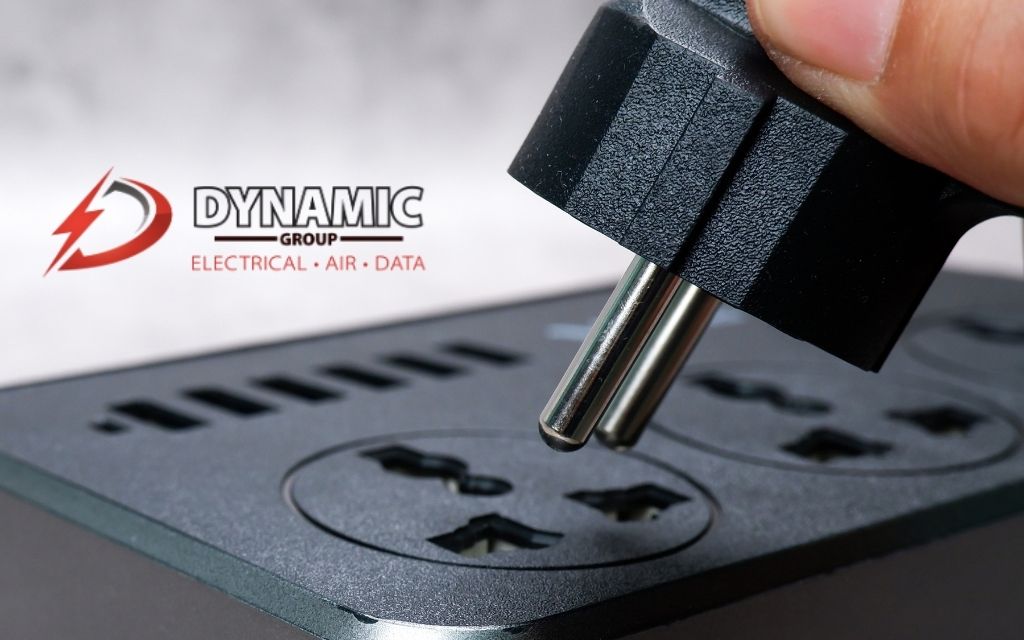
Overview of Global Power Plug Types
When it comes to power plug types, the world is surprisingly diverse.
Over 15 electrical plug types are officially recognised and labelled, ranging from Type A to Type O.
Each country has adopted certain designs based on historical standards, regulations, and electrical infrastructure.
The Most Common Plug Types Worldwide
Here’s a quick snapshot of some major plug types you’ll encounter globally:
- Type A & Type B – Common in the United States and Japan. The Type A plug has two flat, parallel pins, while the Type B plug has a round grounding pin. They are made to work with 100-120 V systems.
- Type C – Widely used across Europe. This type of two-round-pin is one of the most widespread power plug types, but it is not grounded in many instances.
- Type G – Used in the United Kingdom. The Type G plug has three rectangular pins and operates on 230 V.
- Type I – Used in Australia and New Zealand. It is the Australian power plug type, the Type I power plug, or the type 1 power plug. It has two angled flat pins and one vertical grounding pin. If you’re wondering what type of plug Australia uses, the answer is Type I.
One common misconception is that plug shape determines voltage — but that’s not how it works.
The power plug type is only the physical appearance of the outlet plug and socket.
Voltage, on the other hand, is the electrical pressure applied to that system. For example:
- The US (Type A & B) operates on around 120V.
- The UK (Type G) runs on 230V.
- The Australian power plug system also runs on 230–240V.
So even if the voltages of two nations are similar, the plugs used may fail to fit. And even when an adapter makes your device fit in an Australian wall plug, it does not necessarily mean that the voltage is safe for your device.
What Plug Type Does Australia Use?
In everyday life across Australia, the standard outlet you’ll see in homes, offices, and public spaces uses a specific configuration known as the Type I plug — the official Australian power plug type under the harmonised Australian/New Zealand standard (AS/NZS 3112).
The Type I plug is a grounded electrical plug in which the angled flat pins are arranged around a distinctive triangle: the live and neutral copper pins are cut at angles, forming a V shape, with a vertical grounding (earth) pin set slightly lower than the other two.
The triangular design is the only electrical plug type in use worldwide and is easily identifiable.
Here’s how the pins work:
- Two angled flat pins handle the live (active) and neutral lines.
- One vertical pin — the earth or ground — sits slightly longer, so it makes contact first for safety.
- Many modern versions also include insulation along the live and neutral pins partway down, reducing the risk of shock during insertion or removal.
Australian electricity is normally delivered at 230–240 volts AC at 50 Hz, higher than in many other countries.
Why Australia Uses the Type I Configuration
Australia’s choice of the Type I configuration was not accidental, but based on safety and practicality:
- The longer earth pin ensures the grounding contact is made before the live and neutral conductors, providing some protection in case of a fault.
- The angled flat pins establish a fixed connection and are easy to produce, which was particularly beneficial in the early history of electrical standards during the 20th century.
- Making the Type I design available to New Zealand and other neighbouring nations makes it easier to achieve appliance compatibility across the region.
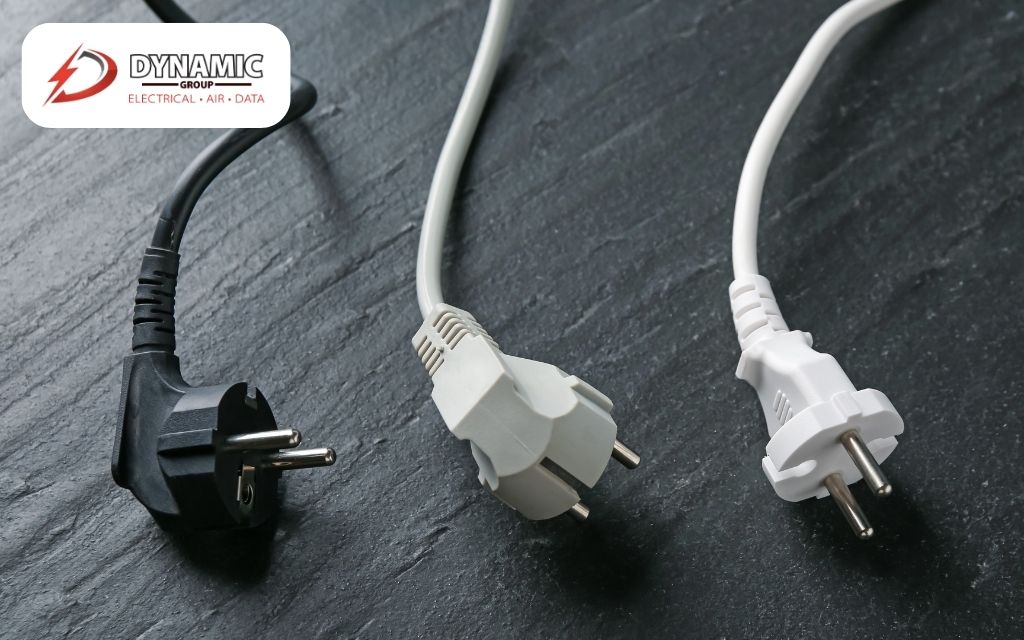
How the Australian Plug Type Compares to Other Power Plug Types
When considering power plug types, it is useful to compare the Australian standard with those of the major systems worldwide.
Although 230 V electrical systems are common in many countries, the shapes of plugs and socket standards may be entirely dissimilar, so your device may or may not fit without an adapter.
Type I vs Type A (US Plug)
Shape Differences
- The Type I plug – the standard of electrical plugs used in Australia – has two angled flat pins where the V meets and a vertical earth pin.
- Type A plugs (used in the United States and Japan), in contrast, have two parallel flat pins with no grounding pin.
Voltage Differences
- American outlets using Type A typically supply around 120 V at 60 Hz.
- Australia’s grid — where the Type I plug is standard — supplies about 230–240 V at 50 Hz.
Due to this voltage difference, although the plug may physically fit with an adapter, most US appliances cannot operate safely in Australia without a voltage converter or a dual-voltage appliance.
Type I vs Type G (UK Plug)
Completely Different Pin Shape
- The Type G plug, the standard in the United Kingdom and some former British territories, has three rectangular pins arranged in a triangle.
- Meanwhile, the Australian Type I plug uses flat-angled pins with a vertical earth pin.
Because the pin’s shape and size differ, a Type G plug will never fit into a Type I outlet (and vice versa) without a proper universal adapter that accommodates the physical and electrical differences.
Is New Zealand’s Plug the Same as Australia’s?
New Zealand utilises the same plug as Australia; the Type I plug.
The voltage and frequency standards used in both countries are also similar (about 230–240 V, 50 Hz), so most devices used in Australia can be plugged into New Zealand without a converter or adapter.
Although the pin dimensions in some countries with Type I may have minor regional variations, the standards of Australia and New Zealand are harmonised with AS/NZS 3112.
The Type I plug isn’t exclusive to just Australia and New Zealand. It is common in other countries in Oceania and elsewhere, such as Fiji, Papua New Guinea, Samoa, the Solomon Islands, Argentina, and, to a certain extent, China; however, the implementation may vary somewhat.
Voltage Compatibility & Device Safety
When researching what plug type Australia uses, most individuals are concerned with the physical appearance of the Type I plug. However, the shape of a plug is half the battle. Voltage can also be an issue.
Although you may have worked out what plug Australia uses and bought the right adapter that fits the Australian plug type, you still must make sure that your device is compatible with Australia’s electrical supply.
Why Plug Shape Isn’t the Only Issue
Most users believe that once they know which plug type is used in Australia, they are now ready. However, it is equally important to know the voltage as it is to understand the type of Australian power plug.
If you are not clear on how power ratings work, reviewing volts, amps, and watts can help us understand how voltage, current, and power consumption interact.
Risk of Damage Without a Converter
Using an incompatible voltage with an Australian electric plug can cause:
- Overheating
- Internal component failure
- Blown fuses
- Fire hazards
Even if the device physically fits into Australian power plugs, if the voltage is wrong, the equipment may be damaged in a few seconds.
To verify the outlet voltage, a brief overview of a multimeter may be helpful. A multimeter will enable you to check the voltage output.
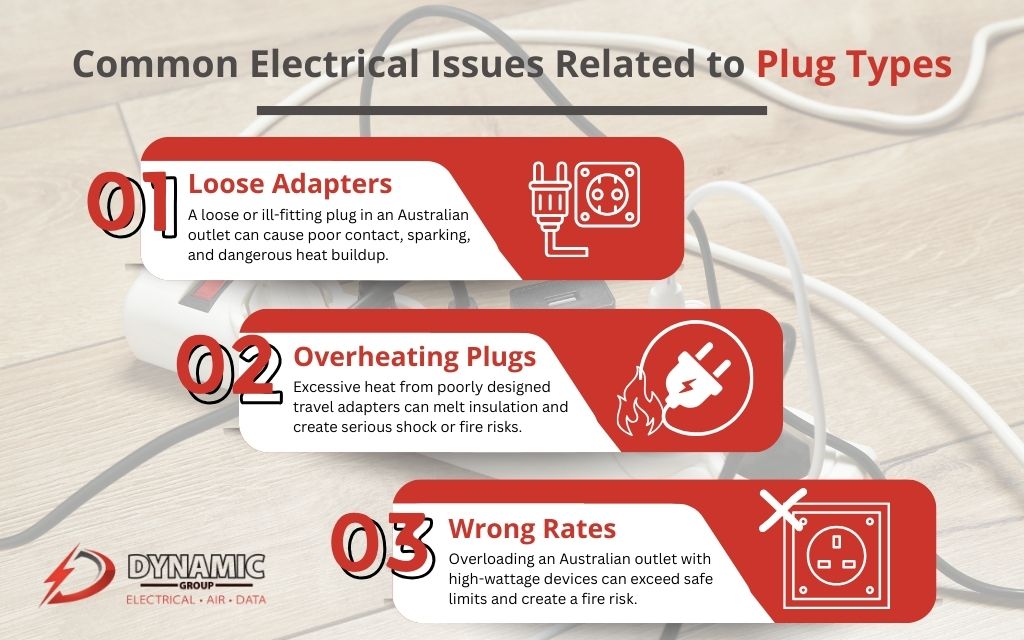
Common Electrical Issues Related to Plug Types
There are still genuine electrical problems that could occur with the power plug setup in Australia, even if you know which plug type Australia uses or have the correct Australian plug adapter.
Let’s break down a few of the most common problems and why they occur.
Loose Adapters
A plug that doesn’t fit snugly into an outlet can be more than irritating; it’s unsafe.
Loose adapters can cause intermittent contact between the plug pins and the socket terminals, leading to arcing (sparks) and heat accumulation around the connection.
It may occur due to using poor-quality travel adapters or attempting to insert an incompatible plug into a socket. When the adapter is not tight, it can overheat even with no heavy load.
Overheating Travel Plugs
Travel adapters and power bricks sometimes run warm under normal conditions, but excessive heat is a red flag.
Poorly designed or cheap adapters can create hazardous temperatures.
Lab tests have revealed that many budget travel adapters can overheat to unsafe surface temperatures in a relatively short time when used continuously, sometimes far beyond recommended safety limits.
Plastic insulation can also soften or melt due to overheating, exposing live components and posing a severe electrical shock or fire risk.
Using Incorrectly Rated Sockets
Even with the correct Australian plug, high-draw appliances will not operate correctly with the wrong type of plug, and overloading a single power point may cause issues.
Australian domestic circuits and outlets generally supply a set amount of current, and operating several high-wattage appliances from the same socket may overload it.
This is often an issue with extension cords or double adapters that technically let you plug even more devices into a single outlet than it was originally designed to handle.
When to Call a Professional
Being aware of which plug type Australia uses is one thing, but changing electrical systems is entirely another.
Electrical work in Australia is governed by very stringent safety standards, including AS/NZS 3000, which governs the design and performance of installations to ensure compliance and safety (Standards Australia).
Electrical installations should comply with state-based electrical safety laws, and in most states, electrical work performed by unlicensed persons is unlawful.
Here’s when you absolutely shouldn’t DIY.
Installing New Outlets
Adding a new Australian wall plug might seem simple, especially if you already understand the Australian plug type or the Type I plug configuration. But installing a new outlet means:
- Extending or modifying fixed wiring
- Ensuring proper earthing
- Matching circuit load capacity
- Maintaining compliance with AS/NZS 3000
Bad installation may lead to overheating, the risk of shock, or even having your circuit breaker trip every time due to improper load balancing.
If you are installing power points in a home, this will be considered professional electrical work, and you will need to hire a registered residential electrician to do the work legally and safely.
Faulty wiring is a major cause of residential electrical fires, according to SafeWork Australia, underscoring the importance of compliance and proper installation.
Converting Socket Types
If you’re relocating from overseas and wondering whether you can convert outlets to match another system — for example, changing from the Australian power plug type (Type I) to another configuration — that’s not a simple faceplate swap.
Australia’s electrical infrastructure is designed around the Type I plug, and installing non-compliant socket systems can violate safety standards and insurance requirements.
A licensed electrician must carry out any modification to fixed electrical wiring to remain compliant with Australian electrical regulations.
Upgrading Switchboards
Older properties in Australia may still have outdated switchboards that lack modern safety devices, such as:
- RCDs (Residual Current Devices)
- RCBOs (combined circuit breaker and RCD protection)
- Surge protection
Modern Australian standards require safety switches on new installations and upgrades to protect against electric shock and fault currents (Energy Safe Victoria; NSW Fair Trading Electrical Safety Guidelines).
If you’re installing additional Australian power plugs, adding heavy-load appliances, or renovating, your switchboard may need to be upgraded to handle increased demand safely.
An overloaded or outdated board can lead to repeated breaker trips, overheating circuits, or increased fire risk.
Compliance with Australian Standards
Electrical work in Australia must comply with:
- AS/NZS 3000 (Wiring Rules)
- AS/NZS 3112 (Plug and socket standard for the Type I plug)
- State-based electrical safety legislation
Licensed electricians are trained to ensure installations meet these requirements, and in many states, a Certificate of Electrical Safety (COES) must be issued after certain types of work.
Attempting unlicensed electrical work can:
- Void home insurance
- Result in fines
- Create serious safety hazards
Conclusion: Choosing the Right Power Plug Type for Australia
By now, it should be clear that understanding Australia’s electrical system isn’t just about knowing the plug shape. Choosing the right setup also means confirming voltage compatibility, checking appliance ratings, and using properly certified equipment.
The biggest mistakes I see happen when people focus only on whether the plug fits. The plug type determines physical compatibility.
The voltage and frequency determine whether your device operates safely. Both need to match.
An adapter alone doesn’t solve a voltage mismatch — and ignoring that detail can lead to damaged appliances, overheating, or tripped circuits.
When it comes to modifying fixed wiring, that’s not something to experiment with. Electrical work in Australia must comply with national standards and be performed by a licensed professional to ensure safety and legal compliance.
If you need dependable, standards-compliant work done, Dynamic Group is a reliable team of electricians that can handle virtually anything electrical. The right expertise makes all the difference when safety and compliance are on the line.
Contact us today to schedule a consultation or request a quote — and make sure your electrical setup is safe, efficient, and built to last.

Unmatched Electrical Services
Explore our services and see why we're recognised as one of Perth's top electrical service providers. Our dedication to exceptional customer care, clear communication, and the unmatched expertise of our experienced team make us stand out.

Competive Rates

Clean Work Sites

5-Star Service

Licenced & Qualified
Get in Touch Now
Complete the form below to get a customised quote or to have your queries answered.