



How to Install a Ceiling Fan in Australia Safely and Correctly
When summer arrives in Australia, keeping your home or workplace comfortable without relying only on air conditioning becomes a priority.
A well-positioned ceiling fan can improve airflow, create a more comfortable indoor environment, and help reduce the need for constant cooling, making it a popular choice for many Australian homes and businesses.
If you are searching for how to install a ceiling fan, you are probably wondering what is involved, what needs to be prepared, and whether the process is as simple as replacing an old light fitting. Understanding the installation process can help you make better decisions.
In this guide, we will walk through how to install a ceiling fan in Australia, covering what to check before installation, the tools and materials required, common installation challenges, safety checks, and why professional electricians in Perth help is needed.
While choosing a fan and preparing the room can be handled by most people, electrical work such as installing ceiling fan wiring, connecting controls, and completing final safety checks should always be completed by a licensed electrician.
At Dynamic Group, our team provides professional ceiling fan installation, ensuring fans are installed safely and securely and ready to handle the Australian climate.
Can You Install a Ceiling Fan Yourself in Australia?
Can I install a ceiling fan myself?
No.
You can prepare yourself for the job, but don’t try to do the wiring or electrical connection.
If you are looking up how to install a ceiling fan, there are several simple things you can do to prepare before we arrive,
You can pick the fan, check the room requirements, clear the area, decide whether you want to use a light or a remote, and make sure everything is set up. This makes things easier for all!
The electric side is the place where it gets serious. There are several steps involved in installing a ceiling fan: installing the fixed wiring, securing the mounting, testing, and ensuring its safety for long-term use. The Government of Western Australia states that before doing any electrical work, you need the right licence.
That means a DIY ceiling fan installation, or a quick weekend attempt at wiring a ceiling fan in Australia, is not worth the risk, even if you only want to replace a ceiling fan.
At Dynamic Group, we often help homeowners who have already bought a fan but want it installed properly.
Our residential electricians can inspect the ceiling support, wiring, controls, and overall operation to ensure that your fan operates safely, quietly, and effectively. That is the best approach: you choose the fan, and we make sure it is installed safely.
Before Installing a Ceiling Fan: What You Need to Check First
Before I install ceiling fans, I prefer to conduct an appropriate room check. It sounds simple, but many ceiling fan issues can be prevented before they even start.
Does the ceiling have a good clearance? Do you have adequate blade clearance from walls, doors, cupboards, bunks or tall furniture?
Ceiling height is important. A ceiling fan must be at least 2.1m to 2.4m for effective performance, and if you have a taller gap, then you’ll need a ceiling fan fitted with an extension rod.
Then compare the fan’s size to the room’s size. A small bedroom and an open-plan living area, office, shop, and alfresco space don’t always require the same fan. The larger isn’t necessarily the better. The fan should circulate air appropriately without blowing too hard or being too loud.
Here is what to check before installing a ceiling fan:
- Ceiling height and blade clearance
- Room size and airflow needs
- Fan weight and mounting requirements
- Whether there is already a light fitting or fan point
- Roof cavity access
- Ceiling support and condition
- Indoor or outdoor location
- Remote, wall control, or fan-light setup
The type of room is also important. A bedroom might require a quieter fan, and an outdoor alfresco area might call for a fan better suited to outdoor use.
At Dynamic Group, our electrical services include checking the wiring, support, and installation setup first, so the fan is not just fitted, but fitted properly.
Step-by-Step of How to Install a Ceiling Fan in Australia
If you are looking for how to install a ceiling fan, remember that this isn’t a how-to guide, but it will acquaint you with what is expected for a proper installation.
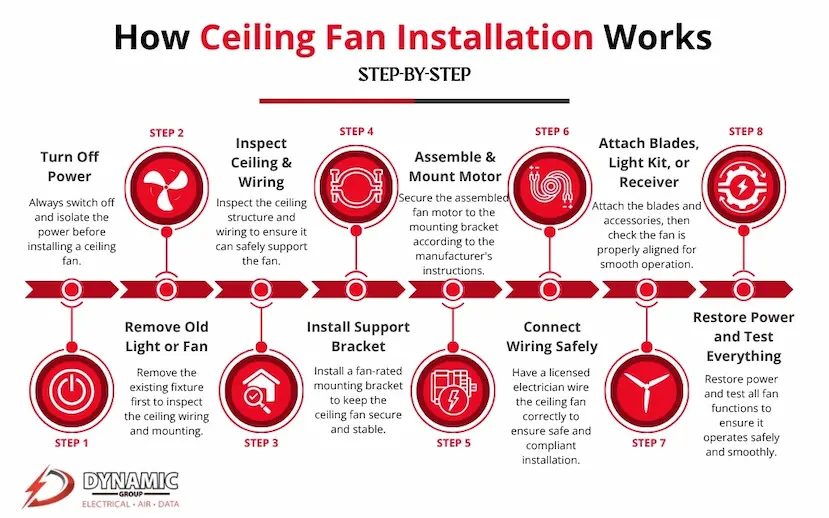
Step 1: Turn Off and Isolate the Power
The power must be turned off and isolated before anything is brought down or taken up. This is one of the most crucial steps in safely installing ceiling fan units.
Electrical work is generally not permitted on or near energised electrical equipment, and equipment should be de-energised before commencing electrical work, says WorkSafe Queensland.
Step 2: Remove the Existing Light or Old Fan
When replacing ceiling fan fittings, always disassemble the fixture that is in place first. It also allows for a good look at what we’re dealing with above the ceiling.
Step 3: Inspect the Ceiling and Wiring
Inspect the existing ceiling structure, the wiring, access to the ceiling cavity and the chosen mounting point. A ceiling fan will move and vibrate and therefore require more support than a normal light fitting.
Step 4: Install a Fan-Rated Support Bracket
Install the appropriate fan-rated bracket/support once a ceiling point is determined. This allows the fan to remain stable and prevents the risk of wobbling, noise and movement over time.
Step 5: Assemble and Mount the Fan Motor
After assembling the fan motor as per the instructions, it is securely attached to the bracket. Product safety is also relevant, as the Electrical Equipment Safety Scheme states that electrical products supplied in Australia are expected to be electrically safe.
Step 6: Connect the Wiring Safely
This process shouldn’t be attempted as a DIY ceiling fan installation. A ceiling fan in Australia can be wired in a few different ways, including a standard fan, a ceiling fan with a light, and a remote receiver or wall control. All these must be wired up correctly by a licensed electrician.
Step 7: Attach the Blades, Light Kit, or Remote Receiver
Once the main unit is stable, attach the blades and install the light kit/remote receiver (if provided). This is also where I check the fan’s alignment to ensure it runs smoothly.
Step 8: Restore Power and Test Everything
Lastly, restoring power and checking all speeds, the light, reverse mode, wall switch, remote control, noise level, and blade balance. We don’t install ceiling fans and run away at Dynamic Group. Before leaving, we ensure the fan is operating correctly.
The exact process may differ depending on the type of fan, the type of ceiling, the condition of the wiring, and whether it is a new installation or a replacement of ceiling fan fittings. Our lighting installation experience ensures that an existing light system is installed safely, tidily, and efficiently, even when the job involves replacing an old one.
Installing a Ceiling Fan Where There Is Already a Light Fitting
In many houses, this can be a convenient choice, but it is not always as straightforward as hanging the light and replacing it with the fan.
If you are installing a ceiling fan in an area that has a light fitting, there are a few things that should be reviewed:
- Is the existing wiring suitable for the fan and light setup?
- Is there enough ceiling support for the fan’s weight and movement?
- Will the fan need a remote receiver or wall control?
- Is there enough blade clearance from walls, wardrobes, doors, or bunks?
- Is the home older, with wiring that may need a closer look?
The most important thing to keep in mind is that a ceiling fan is moving, vibrating, and weighing more than a standard light fitting.
According to some manufacturers’ instructions, the hanging bracket must be attached to a ceiling joist or a sturdy ceiling structure capable of supporting the fan’s weight, with adequate clearance from other walls or objects.
It’s also about the wiring side. When wiring a ceiling fan in Australia, it’s important to know that the electrical work must be done by someone who’s licensed and experienced.
Dynamic Group don’t just guess at the colours of the wires. The setup is checked correctly, including colours of the electrical wiring, support point, controls, and final operation.
Yes, it’s sometimes easy to replace a ceiling fan, but it is important to do it safely and securely, with someone who knows what they are doing.
Installing a Ceiling Fan Where There Is No Existing Fixture
If you don’t have a light fitting or fan point in place, installing a ceiling fan will be more complicated. I am not merely removing one fixture and installing another.
I have to consider how to safely get power to that new location, how the fan will be controlled, and whether the ceiling can support it.
When looking at how to install a ceiling fan in a new location, here are some of the primary things to look into:
- Is there a roof cavity access above the room?
- Is there a nearby electrical point we can legally and safely work from?
- Does the ceiling need extra timber or fan-rated support?
- Will the fan need a new wall switch or remote receiver?
- Is the ceiling high, raked, concrete, or hard to access?
- Is the room a bedroom, living area, alfresco, office, or shop?
We also consider the new fan in relation to the other components of the area. That could be installing a new switch, setting up controls in an orderly fashion, or any other work related to the project, such as installing a powerpoint.
The objective is straightforward: set up and secure the ceiling fan and make it look like it was always meant to be there.
Common Ceiling Fan Installation Problems
While a fan may seem to be in good condition, it can present a few issues during or after installation. A few are simple solutions. Others are warning signs that require proper electrical fault-finding.
The most common ones I see are:
- The fan wobbles: This might occur due to unbalanced blades, loose screws, or a weak mounting base.
- There is a clicking or scraping noise: Sometimes it’s a blade alignment problem. Other times, the fan hasn’t been put together or fastened correctly.
- The airflow feels weak: it could be too small, mounted too high, turned in the wrong fan direction, or blocked by poor placement.
- The fan will not turn on: This may be due to a remote control, wall switch, receiver, or wiring issue.
- The light does not work: This is where many people discover the fan-light system is not as simple as it sounds.
- The remote will not pair: This can range from batteries to settings; however, the receiver may also require a check.
- The power trips: When the circuit breaker trips repeatedly, do not keep resetting it; wait for it to reset on its own. Testing safety switches twice yearly to help minimise the risk of electric shock and fire.
When you are looking for information on installing a ceiling fan in Australia, this is where you should listen. If any of these issues are repeated, such as the crackling noise, power outage, or foul odour, they should never be ignored.
Safety Checks After the Ceiling Fan Is Installed
After installing ceiling fans, it’s time to perform the final checks to ensure the fans are safe, steady, and working properly.
Check for:
- Every fan speed setting
- Summer and winter reverse function
- Light operation, if it is a fan-light model
- Wall switch or remote-control function
- Blade balance and movement
- Noise level while running
- Stability of the mounting point
- Any flickering, buzzing, or signs of power tripping
A ceiling fan should not wobble excessively, scrape, flicker, make odd sounds or trip the power.
If a person feels a shock or tingle when using electrical equipment, stopping use and contacting the electricity distributor or asking a licensed electrician to check the equipment is the best option.
This is why I always tell people that how to install a ceiling fan is not just about getting the fan onto the ceiling. It is also about testing everything properly afterwards.
At Dynamic Group, we discuss any concerns we have about the job, including an outdated switchboard, poor protection, and old wiring, with the homeowner.
Another reminder that this sort of work must be checked and documented, licensed electricians are required to provide a Certificate of Electrical Safety after they finish electrical installation work.
We strive to make your fan run smoothly, safely, and quietly. If the installation is part of a larger problem with the electric wiring in your home, we may also be able to upgrade the switchboard to ensure your home can safely power modern electrical appliances.
When Should You Call an Electrician?
If you are looking up how to install a ceiling fan, I would suggest calling an electrician before the job gets complicated, not after something goes wrong.
You should get a licensed electrician involved if:
- There is no existing fan point in the ceiling
- The fan is replacing an old light fitting
- The ceiling does not feel strong enough to hold the fan
- The light flickers after the fan is installed
- The circuit breaker keeps tripping
- You notice buzzing, burning smells, or heat around switches
- The wiring looks old or damaged
- You are installing a ceiling fan in a rental, apartment, office, shop, or commercial space
We frequently discover other problems while installing a ceiling fan, including low ceiling support, outdated ceiling wiring, poor connections, or an overloaded electrical circuit. When your fan causes sudden power issues, we can come to your site to diagnose the problem and resolve power outages safely.
But it should also be considered in the larger safety picture. Home safety visits include assessing the working condition and location of smoke alarms.
If we see anything that concerns us during the installation of ceiling fan units, such as outdated wiring or inadequate protection, we’ll let you know.
A safe fan installation will not only work today; it should work every day thereafter. It should give you confidence every time you switch it on.
Final Thoughts: Installing a Ceiling Fan the Safe Way
A ceiling fan can be a great addition to any Australian home, apartment, or business when it is chosen and installed correctly. By selecting the right fan size, checking your room layout, and understanding the installation process, you can make sure your new fan is suitable for your space and lifestyle.
However, the most important part of installing a ceiling fan is making sure the electrical connection, mounting, and final testing are completed safely. A properly installed fan should provide strong airflow, better comfort, quiet operation, and reliable performance for years to come.
At Dynamic Group, we help homeowners and businesses with professional ceiling fan installation, from checking the existing setup to completing the final safety checks.
Our licensed electricians make sure your fan is installed correctly, whether you are upgrading a bedroom, replacing an old unit, or adding fans to a commercial space.
Ready to enjoy better airflow this summer? Contact us today to arrange your professional ceiling fan installation and get your fan running safely and efficiently.

Unmatched Electrical Services
Explore our services and see why we're recognised as one of Perth's top electrical service providers. Our dedication to exceptional customer care, clear communication, and the unmatched expertise of our experienced team make us stand out.

Competive Rates

Clean Work Sites

5-Star Service

Licenced & Qualified
Get in Touch Now
Complete the form below to get a customised quote or to have your queries answered.