



Ceiling Fan Size Guide: Why Ceiling Fan Size Matters
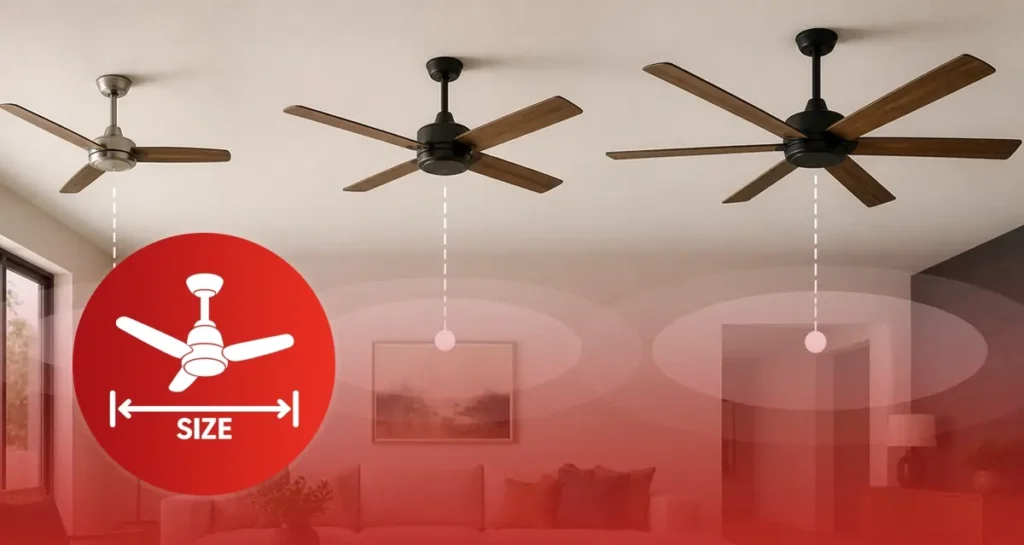
I’ve seen many rooms with fans that are too small, leading to poor airflow and a stuffy feel.
A fan that’s too large can create excess airflow and noise, and can appear out of place.
In this ceiling fan size guide, I’ll walk through everything you need to know about ceiling fan basics. We’ll help you determine which ceiling fan size works best for your room.
And while choosing the correct fan is important, proper installation matters just as much. Professional ceiling fan installation helps ensure the fan is mounted securely, wired safely, and balanced correctly so it performs the way it should.
At Dynamic Group, we often see how the right combination of fan size and proper installation can completely transform a room’s comfort.
Understanding Ceiling Fan Measurements
The first step in selecting a fan correctly is understanding how ceiling fans are measured.
Many homeowners consult a ceiling fan size guide because an incorrect choice of size can reduce air circulation, make a room too stuffy, or generate unnecessary noise.
Learning the basic measurements will help you find the best ceiling fan size that fits your space and prevent proportion errors.
Although fan sizes might initially appear complex, they usually come down to three main dimensions: the width of the blade (the distance from one side of a single fan blade to the other side), the length of the downrod (the metal rod connecting the fan to the ceiling), and the overall clearance (the distance from the blades to the nearest surface or object).
These measurements will help identify the size of the ceiling fan that fits a particular room and allows it to operate safely and effectively.
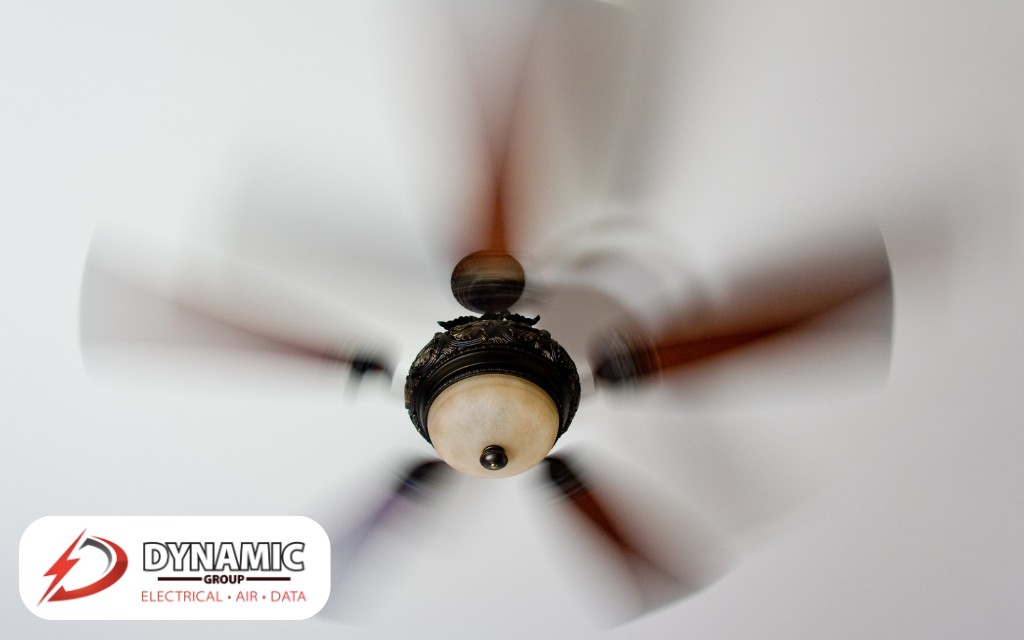
What Is Ceiling Fan Blade Span?
The blade span or the diameter of the circle formed by the blades on rotation is the most significant measure when selecting a fan.
This measurement is key in most sizing charts and tools for determining the size of the ceiling fan you need.
Blade span will be measured from the tip of one blade straight across to the tip of the opposite blade.
When the fan has an odd number of blades, the measurement is taken between the centre of the motor and the tip of one blade, then multiplied by 2.
These ranges represent common standard ceiling fan size categories. For example:
- Small rooms often use a standard fan size between 74 and 91 cm.
- Medium rooms typically require 107–122-cm fans.
- Larger rooms may need 132–152-cm models.
These ranges are often summarised in a fan size chart, which helps you quickly determine the size of fan you need.
Other Important Dimensions
Although blade span is the most commonly used measurement in Australian ceiling fan size guides, other measurements also influence the fan’s effectiveness in your room.
Downrod Length
The downrod is the metal rod connecting the fan motor to the ceiling bracket. Its length determines the distance the fan hangs from the ceiling and significantly affects airflow efficiency.
In rooms with higher ceilings, a longer downrod allows the fan to sit at the optimal height for air circulation.
Even the right fan size might not work without the right downrod length.
Ceiling Height Considerations
Another variable in determining ceiling fan sizes in Australia is the ceiling height.
Ideally, the fan blades must be installed at 2.1 – 2.4 metres above the floor to ensure they are not too high and can allow effective air movement.
For standard ceiling heights, most fans use a short downrod or flush mount design. However, taller ceilings may require longer rods to properly position the fan.
For standard ceiling heights, most fans use a short downrod (a short connecting rod between the motor and the ceiling) or a flush-mount design (the fan mounted directly to the ceiling with no gap), depending on what best suits the space.
Clearance From Walls and Furniture
Proper fan clearance is important for both safety and performance.
The majority of manufacturers advise maintaining a distance of at least 45-60 cm between the blade points and nearby walls or large furniture.
This clearance is important to ensure the fan can move air effectively and minimise the risk of obstruction.
When choosing ceiling fan size for bedroom installations or other smaller spaces, this spacing helps determine whether a compact fan or a larger model will fit comfortably.
Ceiling Fan Size Chart by Room Size
Choosing the right fan becomes much easier when you match the fan size to the room dimensions. Most ceiling fan size guide recommendations use the room’s floor area to determine the best blade span. This ensures the fan can circulate air effectively without being too small or overpowering the space.
If the fan is too small, it may struggle to move air across the entire room. If it’s too large, it can create excessive airflow and noise.
Below is a simple metric guide showing common ceiling fan sizes in Australia, and recommendations based on room size.
| Room Size | Recommended Fan Size |
|---|---|
| Up to 7 m² | 75–90 cm |
| 7–13 m² | 90–105 cm |
| 13–21 m² | 110–120 cm |
| 21–37 m² | 125–135 cm |
| Over 37 m² | 150 cm or larger |
This table reflects common standard ceiling fan size ranges and is a quick way to estimate what size fan you’ll need when planning a new installation.
Choosing the Right Fan for Different Rooms
It is not merely a matter of style when choosing the right fan; it is also about adapting the fan size to the room to achieve optimal air circulation and comfort.
An effective ceiling fan size guide will suggest different fan sizes based on a room’s floor area and its intended use.
Although a fan size chart may provide a quick guideline, it is also necessary to consider how each room operates.
Bedroom Ceiling Fans
Ordinarily, bedrooms need moderate ventilation and noiseless operation.
When determining the size of a ceiling fan for bedroom spaces, most Australian ceiling fan size guides suggest using a fan with a range of 105 cm to 132 cm, depending on the room size.
Smaller bedrooms under 12 m² would normally have sufficient circulation with a fan under 90–105 cm.
The bigger bedrooms may require 120-132 cm fans to bring in more air.
Living Room Ceiling Fans
Living rooms are often the largest common areas in a house, and hence they generally require larger ceiling fans.
In many cases, a standard ceiling fan size of 132 cm or larger is suitable for most medium- and large-sized living rooms.
If you are asking yourself what size ceiling fan you need for a spacious lounge room, a larger blade span can help circulate the air.
Kitchen and Dining Areas
Smaller, more compact fans are usually more applicable in kitchens and dining rooms.
In such areas, the appropriate ceiling fan size should be selected, as oversized fans can cause excessive air circulation around dining tables and the cooking area.
Most kitchen or dining rooms will fit a standard fan measuring 90-120 cm. This provides free airflow without congesting the room.
Large Open Areas
The ceiling fan dimensions in large commercial areas are much larger than those in typical living rooms.
Offices, restaurants, retail spaces, and warehouses may need large-diameter fans to ensure air moves efficiently over large areas.
In these environments, determining the size of the ceiling fan often involves considering the floor area and the ceiling height.
Large commercial fans can be more than 150 cm in diameter because they have to move air in large, open spaces.
Since these installations may imply more complex electrical systems, professional planning is usually suggested.
The services of a commercial electrician may be required to ensure the fan system is installed safely and in compliance with electrical requirements.
Ceiling Height and Downrod Length
Ceiling height and downrod length are just as important as ceiling fan dimensions when determining the right installation.
Even if you choose the correct ceiling fan size, improper mounting height can reduce airflow and affect comfort.
The distance between the fan blades and the floor plays a key role in how effectively the fan circulates air.
When deciding what size ceiling fan you need, it’s important to consider not only the fan size for the room’s dimensions but also the height of your ceiling.
Standard Ceilings
Most fans can be installed with the downrod included with the unit for rooms with standard ceiling height, approximately 2.4–2.7 metres.
Typical ceiling fan sizes used in Australia (e.g., 122 cm or 132 cm blade span) are suitable for bedrooms and living areas.
High Ceilings and Vaulted Ceilings
Rooms with ceilings over 2.7 metres tend to require a longer downrod to position the fan at the ideal height to improve air circulation.
Even the ideal fan size might not circulate air without the appropriate downrod.
In large residential houses or open living rooms, selecting the right ceiling fan dimensions is even more critical.
Low-Profile (Hugger) Fans
For rooms with lower ceilings, a low-profile or hugger fan is suitable.
These fans are mounted directly to the ceiling and are designed to maximise clearance while providing airflow.
Minimum Recommended Height From the Floor
For safety and to allow the air to flow freely, the ceiling fan blades should be at least 2.1 metres above the floor.
This height will facilitate air circulation without putting you in a position where you accidentally contact the blades.
If you need to install a new fan with new wiring, or install a new fan, it is always prudent to seek the help of a qualified electrical service.
Professional installation guarantees that it is secure, meets electrical standards, and is appropriately installed to fit the design of your room.
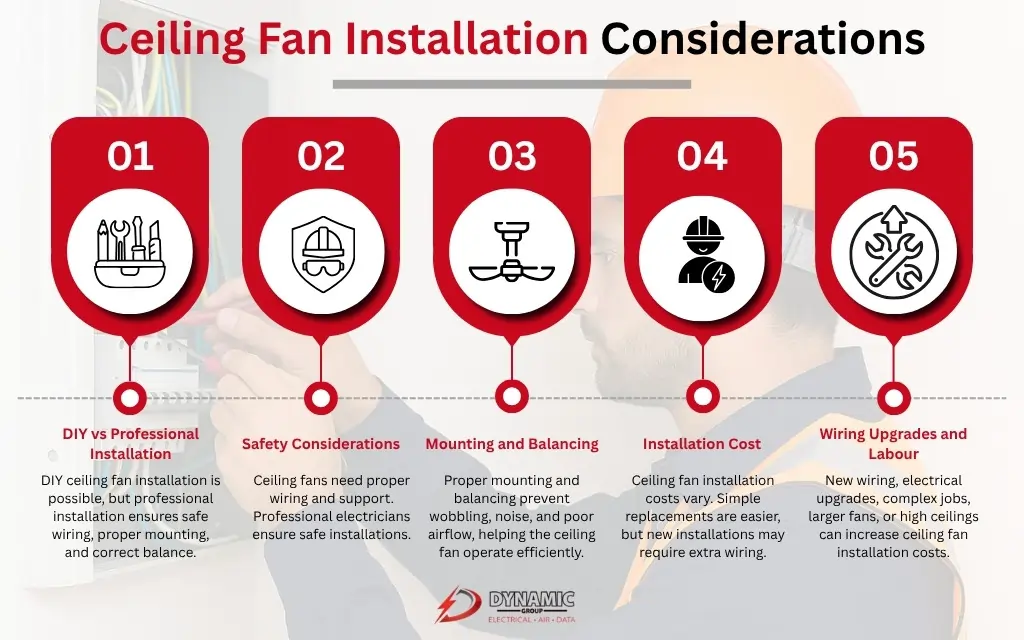
Ceiling Fan Installation Considerations
After selecting the right fan using a ceiling fan size guide, the next step is to install it appropriately.
You may have the right ceiling fan size, but improper installation will lower the performance and pose safety hazards.
DIY vs Professional Installation
Some homeowners choose to install ceiling fans themselves.
However, installing a new fan involves electrical work, proper mounting support, and balancing.
Although DIY installation may be feasible in simple cases, it is recommended to hire a professional for ceiling fan installation to ensure the fan is correctly wired and properly mounted.
This is especially relevant when installing larger ceiling fans in Australia or fans with longer downrods.
Electrical Safety Considerations
Ceiling fans require proper wiring, grounding, and circuit connections.
Fans installed on ceilings require appropriate connections, grounding, and wiring.
If the current wiring is outdated or the electrical box cannot support ceiling fans, upgrades may be required before installation.
The larger the fans, the greater the safety considerations, since larger fans may exert more strain on the mounting hardware and electrical connections.
The connection of the fan to your house’s electrical system should be done by a professionally trained residential electrician, as it is a potentially dangerous undertaking, particularly when installing a new fixture rather than replacing an old one.
Mounting and Balancing
Correct mounting is required to ensure the fan operates smoothly. Unless a fan is correctly settled or mounted on the appropriate bracket, it will either wobble, make noise or decrease airflow.
Even in selecting the appropriate standard ceiling fan size, improper balancing may render the fan inefficient. It is also important to ensure that the fan blades are correctly aligned and firmly secured so that air flows steadily throughout the room.
Average Ceiling Fan Installation Cost
The overall cost of installing a ceiling fan may vary depending on several factors. Simple replacements can be very easy to carry out, but more complex installations may require additional labour.
In most situations, adding a fan to a place that previously had only a light may require additional wiring or reinforcement of the mounting bracket.
Wiring Upgrades and Labour
If demand for new wiring arises or if the electrical box needs to be upgraded to accommodate the fan, this can increase the electrician’s overall rate. The wiring in old homes may need to be upgraded to support modern fans.
Labour costs may also vary depending on the complexity of the work, the number of fans being installed, and whether additional electrical work will be required.
Larger ceiling fan dimensions or high-ceiling installations can also require more time and specialised equipment.
Common Ceiling Fan Sizing Mistakes
Even when using a reliable ceiling fan size guide, it’s still possible to make mistakes when selecting or installing a fan.
Understanding these common mistakes can help you choose the correct ceiling fan size and ensure the fan performs effectively in your space.
Choosing a Fan That Is Too Small
One of the most common mistakes is choosing a fan that is too small for the room. Many people assume a smaller fan will still provide enough airflow, but an undersized fan often struggles to circulate air properly.
If you’re unsure what size fan you need, we can help determine the right ceiling fan size for your room’s floor area.
Installing a Fan Too High or Too Low
Another common mistake involves incorrect mounting height. Even if you select the right ceiling fan size, installing it at the wrong height can reduce airflow and comfort.
This is why many ceiling fan size guides in Australia also include advice about downrod length and ceiling height.
When determining what size ceiling fan for your room, consider both the ceiling fan dimensions and the installation height.
Ignoring Room Layout
Room layout plays a major role in determining the correct fan size for room airflow coverage.
For example, a long, rectangular room might benefit from two fans rather than a single large unit. Using a fan size chart can provide a starting point, but understanding the layout helps ensure the fan distributes air evenly throughout the space.
Overlooking Airflow Requirements
Not all fans with the same ceiling fan sizes produce the same airflow. Motor efficiency, blade design, and fan speed all influence how much air a fan can move.
Two fans with similar dimensions may perform very differently depending on their designs. This is why airflow ratings should also be considered when deciding what size ceiling fan is best for your space.
Choose the Right Fan Size and Get It Installed Safely!
Choosing the right fan doesn’t have to be complicated. Once you understand the basics of ceiling fan sizes and how they relate to your room dimensions, it becomes much easier to determine which size ceiling fan you need for each space in your home.
If you’re unsure what size fan you need or you want to make sure your fan is installed properly, the team at Dynamic Group can help.
From helping you understand ceiling fan sizes in Australia to ensuring safe and reliable installation, having experienced professionals involved can make the whole process much smoother.
If you’re planning to install a new fan or upgrade an existing one, getting the sizing and installation right the first time will save time and hassle later.
Need help choosing the right fan or getting it installed safely? Contact us today to organise expert advice and professional installation for your home.

Unmatched Electrical Services
Explore our services and see why we're recognised as one of Perth's top electrical service providers. Our dedication to exceptional customer care, clear communication, and the unmatched expertise of our experienced team make us stand out.

Competive Rates

Clean Work Sites

5-Star Service

Licenced & Qualified
Get in Touch Now
Complete the form below to get a customised quote or to have your queries answered.