


AC vs DC Ceiling Fan — Which Is Better for Your Home?
I understand the importance of ceiling fans for saving energy and improving everyday comfort.
Regardless of whether you are trying to reduce air conditioning use or enhance air circulation throughout your house, the type of motor in your fan is a significant factor in its performance and future costs.
Being an electrician in Perth, I have observed a clear shift in the AC vs. DC ceiling fan market over the past few years.
Many people are now asking about the difference between AC and DC ceiling fans, particularly as smart homes and energy-saving habits become more prevalent.
Older AC models are still widely used and trusted, but DC fans are gaining popularity because they run quietly, consume less power, and offer more features.
When customers enquire about the difference between AC and DC fans, the discussion tends to boil down to efficiency, noise, and overall control.
The fundamental difference between DC and AC fans helps you choose the appropriate model for your home.
➜ Related: Which Way Should a Fan Spin in Summer
Understanding the Difference Between AC and DC Motors
When comparing AC vs DC ceiling fans, the most significant variable is the type of motor used to run the fan. Both types of motors have their own mechanisms of operation, which makes it easier to determine whether an AC or DC ceiling fan would fit your room.
How AC Motors Work
Traditional ceiling fans have used AC (alternating current) motors for decades. They operate directly on your home’s electrical system and are therefore easy, reliable, and, in most cases, cheaper.
Due to their long history, AC ceiling fans have remained common in many older houses and remain a reliable option for household cooling.
AC motors are reputed to be more durable than DC motors in the AC fan vs. DC fan debate. They tend to offer simple speed controls and fewer electronic parts, which explains their good reputation for long-term use.
People who upgrade old wiring systems to AC models may prefer them because they are easier to integrate with existing switches.
Learn more about our household electrical services.
How DC Motors Work
DC (direct current) motors operate differently. Instead of using power straight from the mains, a DC ceiling fan converts AC power to DC using a small internal controller.
This technology allows for smoother, more precise motor operation. As a result, DC fans tend to run quieter, start faster, and use significantly less energy.
The DC (direct current) motors are different. A DC ceiling fan does not use main power directly; instead, it converts AC power to DC using a small internal DC controller.
This technology enables smoother, more accurate motor operation. Consequently, DC fans are quieter, start faster, and consume far less energy than AC fans.
A DC motor normally has more speed options, a higher air movement control mechanism, and better functionality with a lower power consumption- the main factors that make most users who are deciding between a DC or an AC ceiling fan turn to the former.
Although power consumption and fan control ultimately determine the difference between AC and DC fans, both types of motors can be used in various settings, depending on the home, budget, and energy-saving objectives.
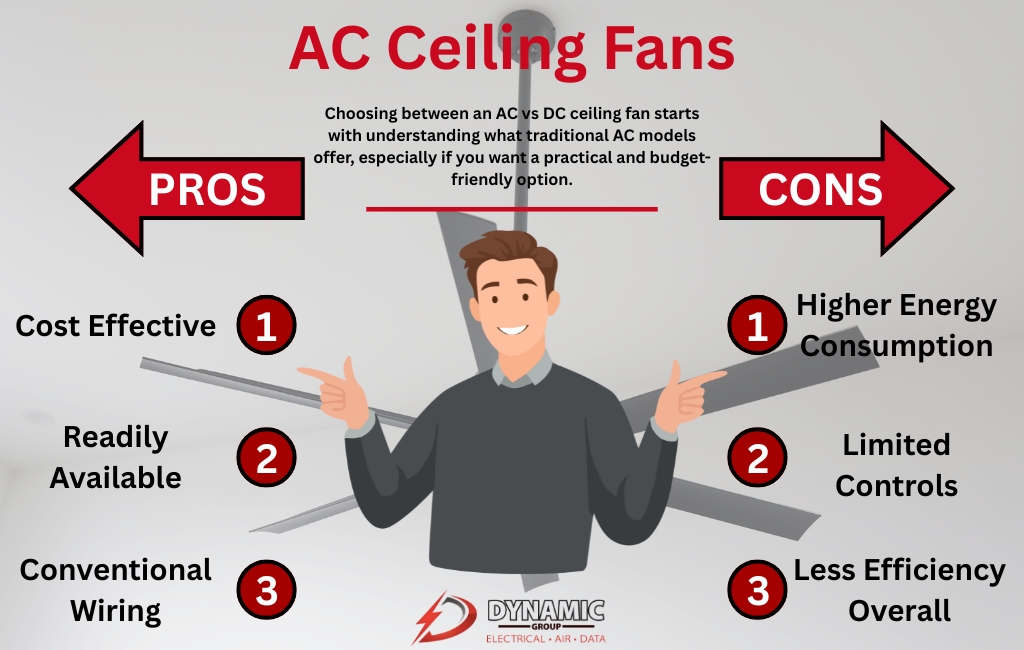
Pros and Cons: AC Ceiling Fans
Choosing between an AC and a DC ceiling fan usually begins with understanding traditional AC models. Although DC fans are gaining popularity, AC ceiling fans are still used in many homes because they are convenient, familiar, and affordable.
Below is a more detailed discussion of the pros and cons to help you determine whether an AC or DC ceiling fan is most appropriate for your location.
Advantages
Due to their simplicity and low cost, AC ceiling fans are still very popular in most households. The following are the key advantages they have:
- Cost-effective: AC ceiling fans are typically cheaper to purchase at the outset and can be used in cost-conscious homes or residential apartments.
- Readily available: AC fans are available in a variety of designs, shapes, and sizes to fit any room, thanks to their decades of market presence.
- Conventional wiring: AC fan wiring can be easily installed in most homes without the need for additional controllers.
A residential electrician can assess whether your wiring is suitable for an AC fan.
Disadvantages
Although AC fans are efficient and commonly used, they also have some shortcomings, particularly when compared to more contemporary DC ceiling fan technology.
- Higher energy consumption than DC fans: AC motors typically consume more power, resulting in higher long-term energy costs.
- Limited advanced controls: Most AC models have fewer speed settings and lack smart-home features that DC options offer.
- Less efficiency overall: Generally speaking, in the bigger AC vs DC fan debate, the former will be perceived as less efficient and less flexible in a contemporary home.
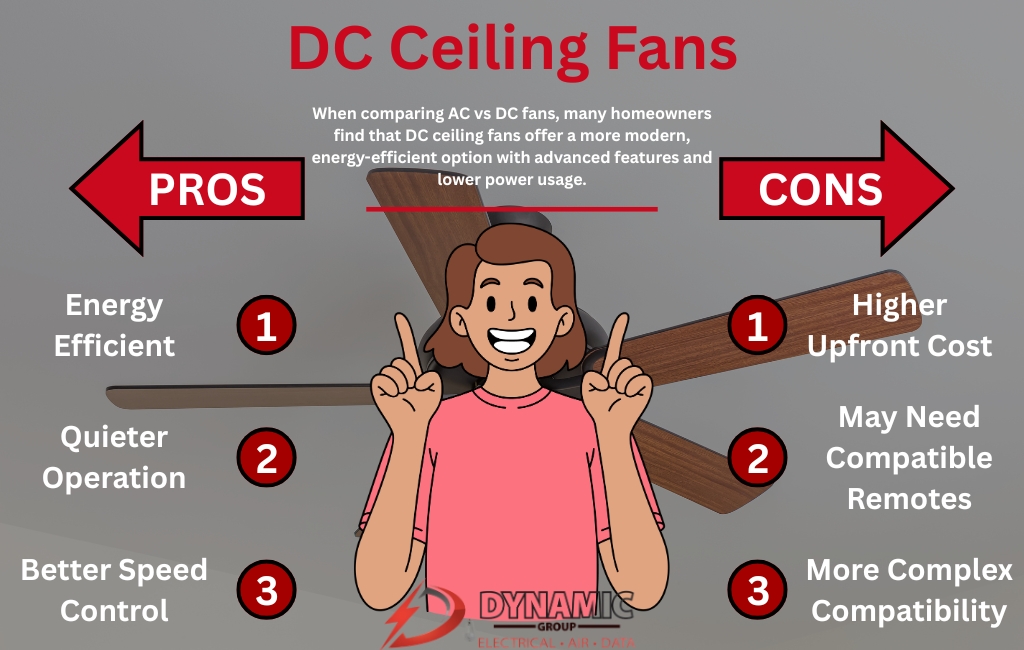
Pros and Cons: DC Ceiling Fans
With the growing prevalence of smart homes and energy-saving practices, DC fans have become popular for their advanced features and low energy consumption. Here’s a balanced look at what DC models bring to the table.
Advantages
The popularity of DC ceiling fans is rising, driven by modern features and strong performance. Key advantages include:
- Energy-efficient: DC motors consume much less power and are therefore suitable for people focused on reducing long-term energy costs.
- Quieter operation: DC fans are quiet, produce less noise, and can be installed anywhere, especially in bedrooms, offices, and study rooms.
- Better speed control and smart features: Many models offer multiple speed levels, remote control, and smart home integration for finer control over airflow.
A commercial electrician may recommend DC fans for large spaces seeking efficiency.
Disadvantages
Although DC ceiling fans are advantageous in this area for their modernity, they also have a few downsides that should be considered before purchase.
- Higher upfront cost: DC fans are typically more expensive upfront, but their energy savings usually offset the cost over time.
- May need compatible remotes or controllers: Since DC motors rely on built-in electronics, most cannot be used with an ordinary wall switch.
- More complex compatibility: Additional electronic components mean setup and troubleshooting cannot be as straightforward as with classic AC models.
Energy Consumption and Cost Comparison
Energy use is typically one of the most important factors when homeowners consider an AC vs. DC ceiling fan. Although both types may provide effective airflow, their power usage is considerably different.
Knowing these differences will enable you to decide which type of fan, AC vs DC ceiling fan, is the most suitable in the long term, depending on your budget and efficiency requirements.
Power Usage Differences
AC ceiling fans usually consume more electricity because their motors draw directly from the mains power supply. This is why, when comparing AC vs DC fans, the AC models are typically on the higher end of wattage consumption.
DC fans, however, convert the incoming AC to DC using an internal controller.
In this way, they can operate much more efficiently. The power used in DC models is typically lower than that of AC models in typical DC vs. AC fan tests, even though both can deliver the same high airflow.
This lower wattage can be a significant difference for households concerned about daily energy consumption.
Long-Term Savings
The actual merit of DC fans is even more evident with time. They use less electricity, which will help reduce utility bills, particularly in homes where ceiling fans are used most of the time.
Although DC fans might be more expensive to install initially, the long-term savings are likely to justify the cost. Enhanced performance can be further improved by pairing energy-efficient fans with updated wiring or smart controls.
Understanding electrician rates in Australia helps estimate total upgrade costs.
Altogether, the difference in energy consumption between AC and DC fans is one of the greatest factors driving DC fans’ growing popularity among energy-conscious homeowners.
Installation Considerations
Another aspect that most homeowners fail to consider when deciding between AC and DC ceiling fans is installation. Although both types can make it more comfortable and improve airflow, the difference is in how they are connected to your home’s electrical system.
Wiring Requirements
AC ceiling fans are generally the simplest to fit as they are directly connected to the existing household wiring. This makes AC models easy to replace or upgrade, particularly the older ones. AC fans will often fit well with a pre-existing circuit with a few modifications.
DC ceiling fans, however, are slightly more complicated. Since DC motors require an internal driver/controller to switch between AC and DC, certain wiring arrangements or compatible wall controls are required in these models.
There may be a couple of additional steps when installing DC fans in homes with outdated wiring or that require advanced controllers.
Professional ceiling fan installation ensures wiring accuracy and safety.
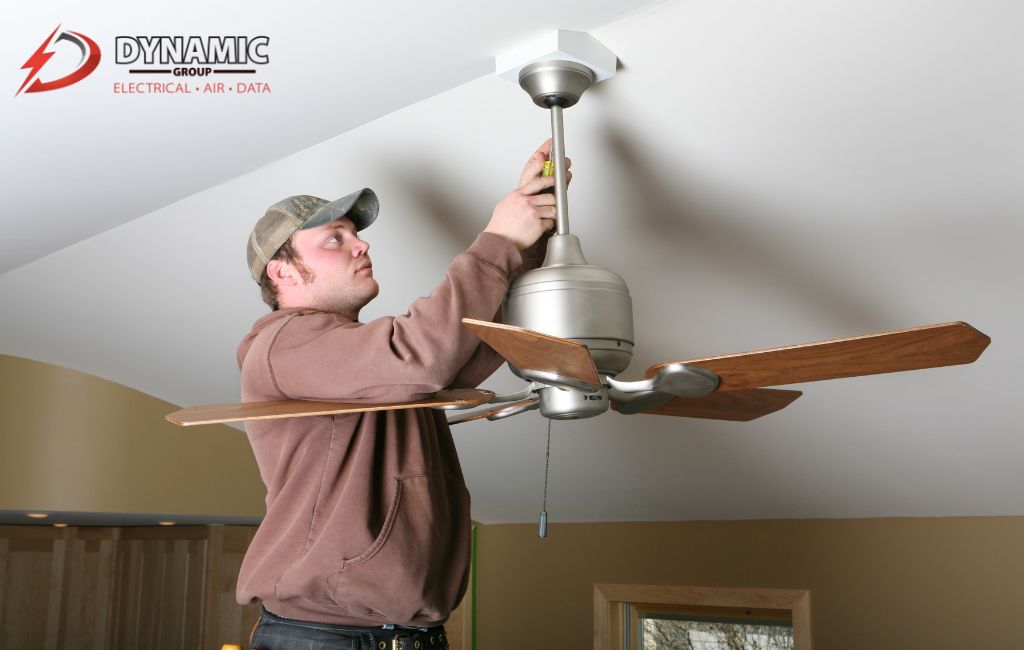
Professional Installation vs DIY
Some homeowners may feel confident enough to install an AC fan on their own, particularly when updating an older unit; however, safety must always come first, and it’s not legal in Australia to install a ceiling fan yourself. It is not always safe to work with active wiring, mounting brackets, and ceiling boxes without the necessary experience.
DC ceiling fans with electronic controllers and other smart features usually require professional installation to ensure everything functions correctly. This is especially true when remotes, smart systems, or multi-speed controls are incorporated.
In general, whether you’re installing a DC fan or an AC fan, it’s best to call a professional if:
- Your home’s wiring is outdated
- You’re adding a fan where no fixture previously existed
- The fan includes smart or advanced control systems
- You’re unsure about electrical safety
- A safe, properly installed fan not only runs better but also lasts longer.
Cost Breakdown
When deciding whether to buy an AC or DC ceiling fan, cost is often just as important as performance or features. Knowing the cost breakdown will help the homeowner select the most suitable option within their budget.
Fan Purchase Cost
Overall, AC ceiling fans cost less initially. Since AC motors are easier to manufacture and have been used in ceiling fans for decades, manufacturers can produce them at a lower cost. This leaves AC models at the low end of the market.
DC ceiling fans, on the other hand, would be priced higher. The high-tech motors, higher efficiency, and other modern devices commonly found in them increase production costs. Nevertheless, most homeowners believe that long-term energy savings justify the investment.
Installation Expenses
Installation prices vary based on several factors, including wiring, the size of the fans used, the height of the ceiling where the fans are installed, and whether the old fan is being replaced or a brand-new one is being installed.
In most households, AC fans are easy to install because they use the available wiring and regular switches.
Depending on the fans and their installation, DC fans might require additional installation or a relay controller, which affects the process.
In others, the additional steps required may add a minor amount to the overall cost of installation – a consideration to bear in mind when comparing DC vs AC fan upgrades.
Reviewing the cost of ceiling fan installation helps homeowners budget effectively.
When all factors are considered, the cost of installation of both AC and DC fans can be relatively low.
Troubleshooting Common Issues
Even with an AC or DC ceiling fan, problems may arise over time. By being aware of popular issues and how to correct them, it would be easier to keep your fan running in a healthy, efficient way.
Below are some common troubleshooting issues for both AC and DC fan models.
AC Fan Problems
AC ceiling fans are generally quite stable, but they may experience several common problems, particularly in older houses.
The humming or buzzing motor is one of the most widespread issues, which can be attributed to loose components, damaged bearings, or electrical disturbance.
Another common issue and a regular cause of wobbling is the unbalanced blades or incorrect mounting.
Speed problems, in which fans operate at only some speed or cannot run at full power, can also occur.
Such issues can be associated with the capacitor, wiring, or the wall switch.
DC Fan Problems
DC ceiling fans are equipped with advanced electronics, so their troubleshooting requirements differ slightly from those of AC units. Remote pairing failure is one of the most frequent problems – usually due to signal interference, battery depletion or improper configuration.
Electrical compatibility is another issue that may be of concern. DC fans also generate power internally, so they can fail to operate properly if the controller is broken or the wiring is not designed to fit the fan.
When the internal driver fails, control failures may also happen, including unresponsive speed settings or unreliable airflow.
Since DC fans use more advanced components, diagnosing issues may require a closer look at the electronics in some cases.
Professional fault-finding helps quickly diagnose wiring or control issues.
Which Ceiling Fan Should You Choose?
Whether you choose an AC or DC ceiling fan depends on your priorities, budget, and home setup. Each type has its own advantages, so understanding your needs can make the decision easier.
- Budget-conscious homeowners → AC fan
- When the primary consideration is keeping upfront costs low, an AC ceiling fan is usually the best option. AC models are popular, inexpensive, and easy to install with standard household wiring.
- Energy efficiency focused → DC fan.
- A DC vs. AC fan comparison would lean toward the DC model for those looking to lower electricity bills and save energy. DC fans consume much less power, make less noise and are more economical in the long term, even though the upfront purchase cost might be high.
- Smart-home integrations → DC fan
- A DC ceiling fan option comes with advanced features, multiple speed levels, and compatibility with smart home integration or remote control. DC fans are often equipped with remote controls or app support so that you can control airflow and comfort exactly.
With these scenarios in mind, you can find the fan that suits best in terms of cost, efficiency, and convenience- be it a model of a conventional AC fan or a new DC fan.
Improve your Comfort with Our Professional Ceiling Fan Installation!
As an electrician who works with homeowners every day, I have witnessed how an AC or DC ceiling fan can affect comfort, energy consumption, and long-term savings.
In choosing between AC vs DC ceiling fans, I recommend looking at your priorities:
- An AC fan is a convenient option if you want the most cost-effective option.
- A DC model would typically be the more favourable long-term investment in case energy savings and extended features are what you prioritise.
- DC fans usually provide the most seamless integration for smart-home installations.
At Dynamic Group, we will assist you in selecting the appropriate fan and installing it safely and professionally, whether you are upgrading a single room or undertaking a complete home renovation project.
We will improve your home’s comfort and efficiency. Call us today and get expert advice and professional installation.
Unmatched Electrical Services
Explore our services and see why we're recognised as one of Perth's top electrical service providers. Our dedication to exceptional customer care, clear communication, and the unmatched expertise of our experienced team make us stand out.

Competive Rates

Clean Work Sites

5-Star Service

Licenced & Qualified
Get in Touch Now
Complete the form below to get a customised quote or to have your queries answered.